Wednesday, June 23, 2010

Running strength and conditioning

Running isn’t really much of a “strong man’s” sport, is it? I mean, look at the Kenyan runners, our own Steve Moneghetti, Craig Mottram, not to mention Paul Radcliffe and others…you’d hardly call them strong. Rob de Castella was perhaps an exception with his tree-trunk legs, but from the waist up he was pretty scrawny. A gust of wind would blow any field of Olympic distance track finalists away.

But let’s consider this from a different point of view. Go out and try running the 160-200 km or so per week these guys run for a while and see what it does to you. Actually, I’ll save you the effort (and pain) and tell you…it will break you because you simply won’t be strong enough to cope with it. That’s an extreme example, but the principle applies – you need to be strong for the sport you do, especially so when it’s a physically damaging sport like running where your enemy is gravity.

What is the strength these runners have, and how does it relate to the rest of the running – and triathlon – population?

The strength of these runners is in the strength and durability of their whole running infrastructure, that is, all the bones, ligaments, tendons and muscles involved in supporting the action of running. Underpinned by great balance in their running form, their musculature is also in balance so that as they do more and harder running there’s no underlying weaknesses which can manifest to create and overload elsewhere in their body…and subsequently an injury.

Getting to the point of being a “strong” runner in this sense is long and painstaking path. Some people will be blessed with great balance naturally, and can run hard and endlessly without problems. But for more mortals it requires attention to detail…which is where a complementary strength and conditioning program comes into play. Here’s some guidelines for how to approach such a program.

First let’s start with a few definitions.
Total Structural Strength – functional strength. Not the amount of weight you can lift, but the amount of strength you can use in the context of your sport.

Total Structural Stability – postural integrity. Allows us to move our bodies efficiently as a series of levers.

Total Structural Range of Motion - the ability to functionally take advantage of:
  • just the right amount of motion
  • in just the right plane
  • in just the right direction
  • at just the right time

These definitions highlight the overall function and action of our muscles as distinct from the brute force they can apply. It’s a skill to be able to control the application of muscle contractions in the context of the sport you play, whether it’s tennis, football, swimming, biking or running. The better you’re able to coordinate your muscle contractions the better your overall coordination and balance will be.

The first step to developing / improving specific strength and conditioning is to be aware of how your muscles are currently working, and to look for discrepancies and imbalances in an athlete, such as relative speed of movement from one side to the other, favouring one side over the other, muscle activation, weaknesses, and more. The purpose of such a screening is to know what to do to address the problems.

Some basic screening exercises – which are best observed and assessed by someone else – include single-leg hops, single-leg squats, walking lunge, and calf endurance. There’s other upper-body screening exercises, also. A further test that is best assessed by a physio is activation of your glutes – a common problem for many runners is delayed glute activation which results in over-use of your hamstrings, long-term weakening of your glutes and likely ITB and other problems. A minor weakness or lack of balanced functionality – and activation – in one area can lead to problems in other seemingly unrelated areas. A full screening by a knowledgeable and/or qualified person is invaluable.

The next step is to build a strength and conditioning program – plus some neurological re-training – to address your individual weaknesses. Many exercises do not require equipment, and should be incorporated into your weekly training schedule. Typical exercises include things like single-leg squats, lunges, hopping, front and side planks and lots more. Some people will need greater focus on some areas than others, and those with access to a gym, pilates, or other opportunities will be able to do a greater variety of exercises. Above all, you should consult a knowledgeable and/or qualified person for specific advice in your circumstances.

This nature of strength and conditioning is a very valuable addition to a balanced and sensible running – and training – program. Running is the activity which improve your running, and build the specific durability that will help you get the most benefit from your run training. But in the context of overall conditioning of your body, and addressing imbalances and weakness, spending time on complementary strength and conditioning can pay big dividends in keeping you on the track.

Sunday, June 20, 2010

My Achilles Operation

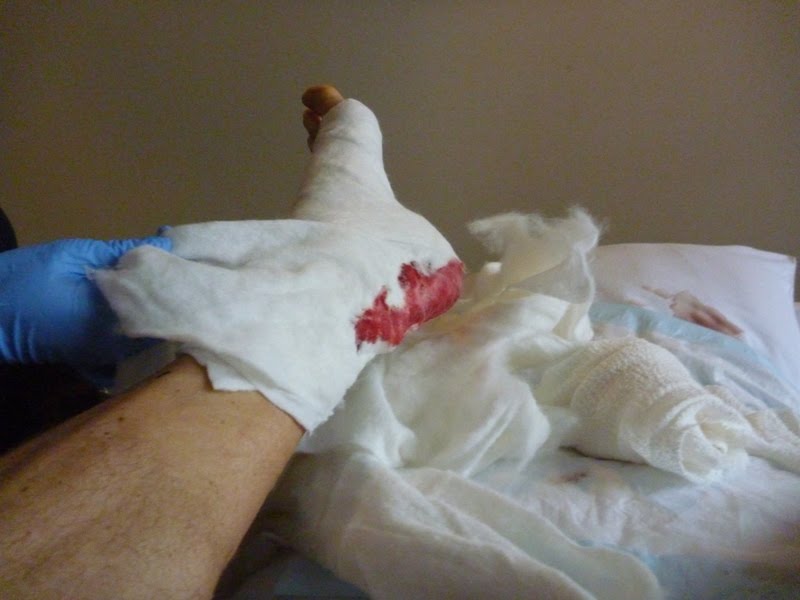
I’m sitting here at the moment barely 24 hours after the Achilles surgery yesterday, and I’m rather incapacitated. My crutches are propped up against the sofa and my leg is up on a pillow with my toes popping out from the bandages covered up with a sock – the only part of my lower leg that’s visible. The nerve block the anesthetist put into my leg is almost worn off, and now I can wiggle my toes after them being completely numb for a while. That was a weird feeling!! The next few days are with my parents, which is great, and helps to off-set the moderate pain and discomfort of the operation. The good news is that the surgery went well. The doctor fixed a small tear in my Achilles, removed a small bit of floating bone and cleaned things up inside my heel. It’s all forward progress from now!!

See some photos below…

Yesterday was the day I was scheduled for the Achilles operation that would hopefully get me back on track and running sometime soon. The procedure was described as “left Achilles repair and debridement”, which I’d explained as being like an afternoon in the backyard to fix a few things and do a general clean-up. I’m a medical layman, after all!!

Check-in time to the Mercy private hospital was 10:30am, and I enjoyed the walk from the tram to the door – the last walking I’d be doing for a while. Entry criteria for the hospital was paying a private health fund excess, just one of the many bills for this adventure, but it was good to have my own room and great care. Having surgery on a Saturday was rather unusual, but nonetheless level 2 was busy with all range of patients being attended to. I was pleased to hear the surgeon was running ahead of time, and so after some pre-operation checks I was wheeled away to lower ground floor and the waiting room, which was also the post-op recovery room.

The Mercy has 10 operating theatres, but only 2 in use yesterday which meant the room was deserted…my me and an orderly and some nurses. The time passed with some good conversation with the nurses (an Irish ex-pat), a visit from the anesthetist (a keen soccer fan who is loving the World Cup), and the surgeon himself, Mark Blackney, who came to say hello and put a mark on my leg to be sure he did the correct one!!

Then it was my turn to be wheeled into the theatre, a room with bright lights, screens, machines, ad lots more besides. It was all a bit of whirlwind as I was shuffled onto the operating table and then had some drugs pumped into me via line into my left arm, and a gas mask put on. The anesthetist previously told me he’d do a nerve block from about my knee down that would numb everything…in 95% of cases at least. I asked how he’d know it I was one of the 5% and he said my heart rate would go up a bit!! Either way, I’d be oblivious to it all as I was soon out to it all from the gas…

Next thing I know I was back in the recovery room feeling very drowsy and peaceful, and my left leg wrapped from just below my knee. The consensus from the nurses was that the operation went well…not that I’d know since my leg was numb and very limp. The post-op procedure was straight-forward, and I was soon wheeled back to my room and popped up with pillows under my leg to keep it elevated. Then it got boring…

Hospitals must rate alongside airports as boring places to wait it out. I channel surfed, played with my iPad, talked to friends on the phone but was still bored. Being confined to bed is just really boring. The regular blood pressure tests were the only thing to break up the monotony a bit. The nerve block lasted until about 3am this morning, when some good drugs took over dulling the pain…happiness in a pill!!

The surgeon dropped in this morning to explain a little more about the operation, and what were the next steps, basically to keep my foot up for the next 2 weeks. A physio bought me some crutches, I got some drugs for the road, and then it was time to head out courtesy of Andrea who came to pick me up (thank-you!!). A 24 hour turn-around and I was starting down the road to recovery. Stay tuned.

The "before" photo, showing the scar from previous surgery 18 years ago.

About to go and be admitted to hospital.

Pre-op, about to be wheeled down to theatre.

Post-op back in my room, still quite drowsy.

Changing the dressing - it bled a bit overnight.

The "after" shot, neatly stictched up and not much swelling. A bit gruesome..

Going home. Love the run!!

Tuesday, June 15, 2010

Hopes

"Remember...hope is a good thing, maybe the best of things. And no good thing ever dies."
Andy Dufresne’s letter to Red from the movie "The Shawshank Redemption"

During the 10+ years I volunteered for the Cancer Council Victoria, the key word used as inspiration for people involved in Relay For Life events was "Hope". It was hope for better outcomes for cancer patients, for their families, for success into research, and more. It was motivated hope - a physical and emotional demonstration of what we hoped would be the eventual outcome of continued support for the Cancer Council, and the work it accomplishes.

Hopes - and the dreams that often underpin them - are an huge part of what makes society work, and progress to occur. We put faith in the things we do, in those around us, and contribute our own energy in the hope that the things we desire will come to being. Hope works on lots of different levels.

In looking around there’s all kinds of hope in people around. There's mothers and fathers hoping their kids grow up happy and healthy. There's business people hoping for success, students hoping they pass exams, pilots hoping their plane doesn't crash, taxi drivers hoping for a good fare, philanthropists hoping their beneficiaries improve their situation. Everyone is hoping for something. Often there's multiple people hoping for different outcomes from the same situation...neither right or wrong, just people with their own hopes.

It's the strength of hope succeeding upon which progress is made...making new discoveries and breakthroughs are made...people pushing beyond their limits to new frontiers, or learning more to improve their knowledge and situation. Hope has been at the heart of great things, from James Cook discovering Australia to Neil Armstrong walking on the moon. Whether it's big or small, personal or open, it's the hope we have that keeps us alive and striving for what we believe in, pulling us inexorably in that direction. Having hopes and dreams, and working towards them, is inspiring.

“There are no hopeless situations; there are only people who have grown hopeless about them."
Clare Boothe Luce, American Diplomat and Writer

But what happens when there is no hope? When it feels like a lost cause. When it seems that night follows night, without day in between. What hope is there then? Well, there IS no hopeless situation. There IS something that can be gained from every scenario...as small and meek as it might be. A kick up the ar*e is a step forward, and that's what is important. Just keep going forwards and you'll build some hope. Winston Churchill once said, "When you're going through hell, keep going." Amen.

This week I'm filled with my own hopes. I hope that the operation I'm lined up for on Saturday goes well. I hope the surgeon has a good day at work...and so too for his anaesthetist, and all the hospital staff. I hope the recovery goes well - something I have a direct role in - and I hope I'm back on track doing the running that I love sooner rather than later. It’s my hope of being able to run again – to race again – that’s motivating me to be a good patient. In the greater scheme of the world my hopes are insignificant, but for now they’re giving me enthusiasm and energy for what’s ahead. I can’t wait.

Thursday, June 10, 2010

Running off the bike

If there's anything that truly defines a triathlon it's the feeling of running off the bike. Whether you've just ridden to the shops or an Ironman bike leg your legs feel dead and heavy, and certainly not primed for running, let alone fast running. This form of running should almost have it's own definition with a similar distinction that "long distance running" has from "ultra running"...not to mention the associated sub-cultures that exist within essentially the same sport!!

How well you run off the bike also determines how well you finish, from age group sprint distance tris to ITU racing and up to Ironman. If you falter in the run leg there'll surely be someone running you down. Sometimes a "slower" runner will outrun a "faster" runner when thrown into a triathlon, which is another defining aspect of triathlons - a better **triathlete** can often beat a better **athlete**.

So, what contributes to running well off the bike, and what are the key criteria for doing so? The main components are fitness (bike & run), tactics, running form and psychology. Let's look at each of these.

Fitness
Fitness is the biggest determinant of your ability to run off the bike. Obviously, if you haven't done any run training then you can't expect to run well, full stop!!

Having said that, your fitness in other sports - swimming and bike riding - can benefit you in running, but consistent with the rule of specificity, the fitness you gain through run training is what will get you through in the long run (pardon the pun).

To contrast the relative benefit of each single-sport fitness - and the relative difficulty of each sport - only a few cyclists could run much further than a kilometre without exhausting themselves. However most runners could ride quite long and hard, albeit not necessarily very well. Running is by far the more demanding sport and by extension running fitness will be more beneficial to running well off the bike than cycling (or swimming) fitness.

Tactics
How you 'use' your relative cycling and running fitness - your tactics - also has a large influence in how you run off the bike. Most athletes have differing abilities between biking and running, even with similar relative fitness levels between the two sports.

Since the bike leg comes first, strong cyclists are often inclined to ride to the limits of their ability - which is usually faster than most - with small regard for the run leg ahead. Then, the longer the run leg the more they're likely to suffer from the extent of their exertion during the ride. Sometimes these kinds of triathletes can pull it off (eg, Normann Stadler in Kona '04 and '06) but more often than not they'll be passed during the run by athletes who rode more conservatively in order to run closer to their potential.

A simple example makes the point clear...if going 5 mins slower on the bike means you run 10 mins faster then your overall time will be 5 mins faster. Basically, going a little slower on the bike will usually mean you run faster by a greater amount off the bike. The fact you might be strong bike rider doesn't change this model - it's relative.

To use an analogy...countries having a nuclear weapon don't ever plan to use it.

Running Form
This is a favourite topic of mine, and as Fitness is related to Tactics, so Running Form is related to Psychology of running off the bike. Running off the bike differs little from 'open' running, although in general it more closely resembles marathon running form than it does track running form. Either way, the basics of good running form still apply - I've previously written about this in How to run.

In triathlon the efficient runner is rewarded with better running off the bike. Specifically, this includes the following:
  • Limiting upper body motion - torso and arms.
  • Holding your torso in an erect position which is more efficient to maintain.
  • Slightly shorter steps, although this is only to ensure running cadence is around 90-95 per leg per min (generally speaking).
  • Minimising vertical movement.

At ITU level it is found that the best runners run at a cadence of about 10 less than they ride at, which links back to tactics on the bike in the gears you ride. It's very difficult to increase your run cadence off the bike, so you're better off riding at a higher cadence in the first place your most recent muscle memory when you start running is at/near that cadence.

The alternative is a slow run cadence, which implies / leads to over-striding which is closely related to poor running form. Because it's a triathlon shouldn't dramatically change your running form.

Psychology
When things get really tough, such as in and half or full Ironman is where running form can really go to pot, and where athletes can tend to "give in" to the circumstances and go into a survival mode of dropping their head, rounding shoulders and back, tilting hips back and basically neglecting most of the most basic aspects of running form.

Even in sprint and Olympic distance events - which are not long races by any means - there's a large number of people who "cave in". I suspect that numerous people have the mindset that "this is a triathlon and I'd doing it tough", and so their body language follows suit and they're almost waving the white flag before even giving themselves a chance to run well.

In this case a change in perspective would help. Think of a triathlon run leg as just a run with a swim and ride beforehand - it is not a world of torment and torture. Remember the fundamentals of running well, the basics of efficient running form and all the things you've done in training many times over. Concentrate, relax and don't be defeated by the scenario.

Psychology is especially important when the weather warms up. Yes, heat does mean a slower pace but it does not mean that survival mode is the only option. On these days it's the people who run positively and with confidence who stand out from the crowd, both in terms of strong running form and actual running pace.

Psychology during the run leg - as well as the whole triathlon - can make a huge difference to your performance, and how well you deal with situations that arise during a race. For running off the bike, a positive mindset is key to running well.

In summary, running off the bike will always be a little slower than 'open' running. But there are still many similarities and the fundamentals don't change. How well you can perform those fundamentals, and maintain them, is the key to running well off the bike.

Tuesday, June 8, 2010

Tough love for Achy-Lee

What does it say when you can count back through the operations you've had to various body parts?

My very first operation was for a broken finger during gymnastics training in when I was 10 yo (nearly lost the finger, and it's still a little out of shape). Then it was a broken elbow needing pins after being knocked off my bike, plus two more operations on my left heel, with the most recent operation being for burst appendix on the opening day of the Sydney Olympics back in 2000 - the opening ceremony looked amaaazing through the haze of post general anaesthetic dopiness. Maybe it's a "boy" thing, but I'm quite proud of the scars I've earned!!

Now I'm booked in for another operation, this time on my left Achilles tendon, which I really hope goes well!!! Since it's going to be quite a journey back to normal, I've decided I need to give a name to the problem area...so please meet Achy-Lee. He's going to be staying for a while.

Today I visited an orthopaedic surgeon, Mr. Mark Blackney. I wondered why he's just "Mr" rather than "Dr"...maybe he's transcended beyond just being a doctor. At the very least, he has a team of people who do the small tasks in support of him sweeping into the appointment room for a few precious minutes of consultation with our parting words being "see you in theatre" (operating theatre, that is...his stage!!).

Before meeting Mr Blackney I was ushered in by a fellow orthopaedic surgeon, David, who's qualified and doing a year of "work experience" (kind of) before hanging up his own shingle and opening practice. He is a really nice guy, and asked me about the background to the injury, the symptoms, treatment, etc, and referred to my MRI scans to cross-reference with what these images were showing. He told about his sporting endeavours, including a finish in the 2006 Bussleton Ironman, and running the Paris marathon. I think he was a little in awe that I got my direct entry into the New York marathon via qualifying time...later describing me to Mr. Blackney as an "elite" runner. Yeah, I liked David!!

My referring doctor, Karen Holzer, asked to speak with Mr. Blackney while I was there and during the delay in actually getting through to her, Mr. Blackney (let's call him Mark from now on) saw a few issues and described some possible options to address them that weren't too invasive. This would mean a quicker return to action, but ultimately might not address the root cause of this and possibly future issues.

Then Karen called back, had a quick chat with Mark during which she explained the MRI report from the radiographer and some thoughts about her vision of taking a long-term view to correction. I think it was very constructive call since as soon as Mark put the phone down the tack had changed to being an operation to do a 'renovation' (my term) rather than just running repairs (my term again...pun intended!!). Tough love for Achy-Lee.

Another member of the team then took over, booking me on for an operation on Saturday 19th June with an overnight stay. After that I'll be on crutches for two weeks - the first week at home with my foot up - and being quite immobile during this time. It's going to drive me nuts. Then I'll be back in this "cam boot" for 4 weeks...the re-hab is going to take a while. All up Mark said three months off running, assuming all goes well. Fingers crossed that it does...

The actual surgery involves repairing a small tear in the Achilles tendon, plus some general ‘clean up’ in and around the area. It sound much like what you’d do during a good afternoon’s work in the backyard!!!

This is a bit of an impact on plans for the year, of course. But once you add a little perspective then it's not so bad, and could be far worse. There's lots of other things - and people - I can direct attention to in the meantime, and to broaden my horizons a little. A good mate sent me some good quotes I'll finish this off with.

If you can find a path with no obstacles, it probably doesn't lead anywhere. ~Frank A. Clark

We must embrace pain and burn it as fuel for our journey. ~Kenji Miyazawa

Adversity enhances this tale we call life. ~Terri Guillemets

Problems are the price you pay for progress. ~Branch Rickey

Saturday, June 5, 2010

Live by the sword, die by the sword

Did you hear about the auto mechanic whose car is broken down, or the botanist whose own garden is dead, or even the financial advisor who’s broke? Or what about the running coach crippled with injuries? Well that last person would be me…

I really don’t like writing about my own predicaments, but in this case I just want to put some thoughts down in words as somewhat of a ‘therapy’. To cut a long story short, in a running context, I’m in some pretty deep sh*t, with many months ahead until I’ll be running again in any shape or form. How did it happen? What’s the prognosis? How do I feel? – those answers are kind of what this blog post is about.

Suffice to say, I love running. I always have, since school, when I’d go for training runs around the country roads around our farm. I remember when I first realised I could run quite well when I popped up out of nowhere to win the Ballarat Grammar School senior lap-of-the-lake in about Year 9 or 10 (in reality, I was just lucky the school was bereft of good runners!!). Running gave way to triathlons after school, filling my desire for a bigger, harder challenge than the single-sport of running could offer.

In my late teens / early twenties I was pretty gung-ho, training hard and racing hard which led to all kinds of problems, some of which included injuries. From my knees down seemed to cop the worst of it – knees, shins and ankles – which began my introduction to occasional cortisone injections (which is a great drug when used at the right time in the right circumstances). Nonetheless, I pushed on always in hope of fulfilling an endless desire to push myself…until the wheels fell off. In particular my left heel.

Over the course of about 18 months (in about 1991-92, I think) I had two operations on my left heel – one to remove a troublesome bursar and another to clear ‘adhesions’ between the Achilles tendon and the surrounding sheath. In hindsight I wish they’d been combined the two procedures. These operations were both a great success and left a fantastic scar about 10cm long on the inside of my heel!!!

At the time I thought these were like visits to the crash repairer, who fixes them up and off you go, good as new. I now realise these operations – and the subsequent scar tissue that’s built up inside my heel over nearly 20 years – has come back to haunt me.

Throughout my life I’ve taken the attitude of living by my actions; planning ahead and then dealing with whatever happens…all the while not looking for any sympathy. I am – and always have been – my own toughest critic. The thoughts and sentiments of others cannot come close to my own, very honest, self-appraisal…for better or worse. Live by the sword, die by the sword.

Fast-forward to recent times and my body has held up remarkably well, albeit with some hiccups at times, and performed quite well through it all. I was looking forward to more great competition ahead, and exhilarated by the thought of it. Then in April my left heel started hurting, again.

At first I thought it was recurrence of the bursitis from about 20 years ago, which was odd since I thought it was meant to be removed in one of those operations. The doctor agreed, although sent me for an ultrasound and cortisone injection. Interestingly, the ultrasound report described the problem as something quite different – a hernia of the fat pad that sits behind the Achilles, putting pressure on the tendon…hence the pain...plus some tendinopathy (aka tendonitis).

The cortisone was partly successful, but the pain still existed although on advice of the doctor and a physio the symptoms still seemed to just indicate some residual inflammation in the area, and that running is OK although we may need to review that if the pain continued. It did, so a visit to another doctor resulted in another cortisone injection in the inflamed area, which was successful in addressing the inflammation. A further doctor appointment (up to my third doctor by now!!) confirmed that I was going in the right direction, and with some more rest things should be OK…based on the symptoms and previous diagnosis.

In hindsight, more attention should have been given to the ultrasound report, and the problems it described, which included some issues that were being skimmed over. Nonetheless, it was me doing the running and me who should have been taking ultimate responsibility for my actions, and listening to my own commonsense. I was riding a roller-coaster of emotions throughout, hope mixed with disappointment and frustration, and lots of other feelings. The prevailing theme was hope, that I was on track to get better.

At the time a friend expressed relief that I wasn’t “locking myself in a dark room listening to Coldplay…”, as a metaphor to describe absolute despair. In context – and as always – things could be a lot worse.

So after much resting, and with everything seeming to be good, it was time to go for a run again. Fail. I couldn’t even make it through 30mins without symptoms, which now included heightened awareness of the Achilles problem mentioned in the ultrasound report (but skimmed over). My reaction was a bit (or a lot) stubborn. I was over it, and kept running thinking, believing and hoping that it was just some more inflammation, and just being ignorant of the fact the pain this time was much more centred around my Achilles, and getting worse. I also had this awful feeling of inevitability about the situation, and that it was heading towards being worst-case…

So I made an appointment with my fourth doctor, this time with someone I knew to be an excellent practitioner with a wealth of experience with elite runners (of which I’m very much not!!), and a network of contacts that opens doors most people find firmly shut. I wish I’d seen Dr. Karen Holzer in the first place.

Dr. Holzer is a woman of action, and made amazing things happen all in the space of a few days last week. It went like this:
5:30pm Wednesday – First appointment. Dr. Holzer manages to book me in for an MRI scan the following day, bypassing the multi-day queues!!
3pm Thursday – MRI scan. I look at the scans myself that evening even I can see the situation looks awful.
12pm Friday – Second appointment with Dr. Holzer. She tells me the situation and pulls more strings for me to see a specialist next Tuesday.

I can’t thank Dr. Holzer enough for her help.

So the diagnosis is of severe tendinopathy (aka tendonitis) in the area around the Achilles tendon, including in the sheath surrounding the tendon, plus a small tear of the Achilles tendon. There’s also a whole lot of scar tissue built up over years from the previous operations, which is/are new fibres created by the body which are not as functional as the original tissue – just like the scar left from a cut on your skin. Scar tissue can also cause problems over time, as in my case, in that it has hindered the function of the Achilles and got to a point where it is perhaps the root cause of my heel problems this time.

Apart from the small tear, I think the Achilles tendon itself is generally OK…which might be akin to saying that apart from a heart attack, the patient is quite well!!!! See, I’m still trying to be a little bit positive…

So I’m off to see a specialist next Tuesday at 11:30am, and not sure what he’ll recommend. My overriding objective is to ensure the long-term health of my Achilles is top priority. If he suggests surgery, I’ll hop into a theatre gown right there and suggest he gets on with it!! Achilles problems are serious, long-term injuries, so however long it takes, whatever it involves then I’m up for it…not that I really have a choice!!

How do I feel?? Well, the feeling of inevitability has come home to roost (so to speak). At least the picture it getting clearer rather than just guessing, hoping, praying. Once I know the full story after Tuesday it will give me something to aim for. Right now I’m resigned to the worst-case scenario, and feeling rather empty.

The worst moment was on Friday afternoon, after picking up a "Cam boot" (like a ski boot, which holds my foot/ankle very rigid) and sitting on a step beside Lennox St in Richmond. This was an external, very visible label of what I’d done to myself, and I really, really, really didn’t like what it was saying.

But I think (hope?) that I’m an inherently positive person, and that is slowly rising up. I’ve had enough of feeling down. Obstacles exist to challenge us to continue, and that I will with as much hope and optimism as I can, not just for myself but for the people nearest to me. We all need each other’s support all the time.

"Tough times don't last but tough people do."
A.C. Green, Retired NBA Basketball Player

Tuesday, May 18, 2010

At least do something

"At least DO SOMETHING! DO! Don't think, DO! Don't hope, DO! At least you can come off and say 'I did this; I shepherded; I played on; at least I did something!" - John Kennedy Snr (1975)

The 1975 VFL Grand Final was a bruising affair - as they usually are - contested between North Melbourne and Hawthorn. North were on top from the beginning, and blew the game apart after half time going on to win by 55 points.

The hapless Hawthorn coach was John Kennedy Snr, renowned for his toughness and skill as a player, and as a coach was notorious for borrowing ideas from any source he thought would inspire the players, embodying passion as much as instruction. His half-time exhortation in the 1975 Grand Final to the Hawthorn players became famous...just imagine a large figure with a booming voice in a long overcoat passionately striding around waving his arms pleading to his players.

"At least DO SOMETHING! DO! Don't think, DO! Don't hope, DO! At least you can come off and say 'I did this; I shepherded; I played on; at least I did something!"

Inspiring and motivating words, in which the key message is don't let the details get in the way of just doing something. A powerful sentiment indeed, and ones many athletes could follow...

You would think that athletes should have no problems with the concept of just doing something, after all they're motivated enough to take up the challenge in the first place. But being the usual Type-A personalities that athletes are can also be a downfall, having a tendency to over think, over analyse and over complicate the whole situation. The problem is that all this mental activity often gets in the way of what they're thinking about...just doing something. Don't think, DO!

Behind all good sports performances is a lot of training and preparation, and the more you get into training the more your realise how many variations there are - and can be - for how to prepare. There's certainly some luck involved in training...and as many people have said, the harder they try the luckier they get. But at the end of the day, often just doing something is more important than the specific details of what you do (...although some general guidance will certainly help). Don't hope, DO!!

In a world where there's more and more devices and gadgets for athletes, whether it's a heart rate monitor, a GPS watch, a power meter - all of which can make a worthwhile contribution to your training and performance - there's a tendency to over think how to use them, or be constrained by the information they tell, or feel limited by not even having one. They're all just tools which don't necessarily make you directly go faster. Use them as a tool, and don't be one. At least DO SOMETHING!

The best athletes don't always get their training spot on, or have a perfect race. Everyone is prone to lapses in form, concentration, motivation and having ups and downs. Van Halen sang "You've got to roll with the punches to get to what's real" in their otherwise banal song "Jump". The athletes who get the most from each performance are the ones who ride out the waves and still get out there to do their best regardless. At least they can say...I did something!

So while there's a lot of value of having the guidance and advice of a coach, training tools and equipment, and a group to share the training with, don't forget that at the end of the day often the best strategy is just to do something.

Wednesday, May 12, 2010

Teamwork

Teamwork comes in all shapes and forms, and a weekend or so ago I was struck by two particular counts of teamwork…one in a movie and one in our running group. What was notable about them for me was they were both optional acts, rather than being part of a planned, cohesive effort. Nonetheless, their significance stuck with me and inspired this post.

The first bit of teamwork was in the film “Coach Carter”, a fantastic film about a hard-ar*ed coach who brings about not just improved on-court performance in the Richmond High School basketball team, but also – and eventually – a complete attitude change within the team about the bigger picture of their direction in life. It’s a compelling film with a lot of great messages throughout.

At one point in the film a player who had previously walked out on the coach – and team – came back and begged to be re-admitted to the team. Coach Carter set him the (impossible) target of 1000 push-ups and 2500 suicide sprints by the end of the week to re-join; it was a test of mental (and physical) wills between coach and athlete. How much did the player want to return to the team? How much did Coach Carter want him back?

The player started on the hopeless task, with subsequent scenes at training showing him in the background going about conquering the challenge. It finally got a point where the player protested to Coach Carter in front of the team about the scale of the challenge, which earned further scorn. The player was in a hopeless position, unwelcomed by the coach because of being unable to complete the re-admittance test.

What happened next was inspiring. One team member got up and said he’d do some of the push-ups, reasoning to Coach Carter that a true team shares the work in order to accomplish things. Then another team member joined in, and another, and another until the whole team was completing the remaining pushups and “suicides” so the outcast player could re-join the team. It was a powerful physical and emotional demonstration of teamwork and support.

Two days later some runners from our group were competing in the Puffing Billy Great Train Race fun run, which we’d penciled in weeks earlier as part of our preparation for the Gold Coast marathon, and entered as a team. Unfortunately one of our runners ran (pardon the pun!) into some knee problems and couldn’t run…a really frustrating and disappointing situation.

When you’re part of a group training for a common goal all you want to do is be out there amongst the activity, in the excitement and energy of the sport. When you can’t do what you really want to do, it brings your spirits to the shuddering halt.

In this situation our runner could have responded in many ways, including being down and depressed, and putting up the shutters to the world and her beloved sport. But instead she rose above her predicament and came up to support her training partners – her team mates – in their race. She was there for us, and not to wallow in her own sorrows…which I’m sure were bubbling in midst of the event. She was fantastic and never once moaned about what she was missing out on, rather showing her excitement at being part of the results we all had.

I’m not sure if she realised the significance of her act – of whether the rest of us did also – but it was also a powerful physical and emotional demonstration of teamwork and support that I’ll remember for a while.

I’d say that teamwork is as much about the little things that are done within a group of people, as it is about the high profile actions. It’s acting with the interests of others in mind, where actions speak so much louder than words. Teamwork is doing what your heart knows is a good thing to do.

Friday, April 30, 2010

Tired and Fatigued

"I'm tired." How often have you heard that said...or even said it yourself? For as sure as night follows day, so we get tired just from living, and then have a sleep to get back things back in balance by the next morning. It's a never ending cycle in our life, no matter how macho, determined or strong you are - get tired, rest (sleep), get tired, rest, get tired, etc.

But the term "I'm tired" takes on some extra meaning in the context of sports training and performance...not to mention for long distance truck drivers, rave party go-ers, and others!! There's not much that kills energy and enthusiasm as quickly as tiredness...let alone when it becomes fatigue. And therein lies the basis for this article, recognising and understanding the difference between being tired and fatigued, and how to respond to each.

We all know that training (let alone racing!) makes you tired. It's hard work, after all, so in a way getting tired is somewhat of a desired outcome since it means you're training hard...not withstanding all the other stresses in life that also contribute to your tiredness!! So in effect tiredness also indicates a degree of overload on your body, also a desired situation...as long as you manage the degree of tiredness.

For our purposes being tired is a good thing. It's an acute (ie, short-term) response to your daily activities and training. It's very important to be aware of your tiredness and over time, develop a good understanding of what it feels like to your body and mind. I've found that tiredness comes in different shapes and forms...you can be sleepy from staying up late, weary the next day from getting to bed late last night, tired from a hard / long session, and more.

Sometimes the same circumstances might result in a different feeling of tiredness...it's very intangible, as is the response and performance of your body in that situation. For example, you might shake off late-night weariness just by getting started, whereas tired legs from a tough hill session will be different. Get to know and be familiar with being tired, and what you can cope with in those situations. Sometimes you can add to the tiredness with more training, and accumulate training overload, but other times you'll learn that you need to rest as you're on the edge...and it only takes a day or so recover from being tired. This experience is critical to avoiding what might come next...fatigue!!

Multi-day adventure racers talk about "sleep monsters", which are the imaginary figures you see when you're too tired to think clearly. These guys are clearly fatigued, being somewhat further along the scale beyond tiredness!!! Fatigue is an advanced - or extreme - state of tiredness, where the training overload has mostly gone too far to be productive. Fatigue is not something you can shake off with a coffee or hot shower, it is deep set and can take some time to overcome. Fatigue can turn into a positive if it's addressed promptly and seriously. Ignoring it can send you into a deep spiral where Chronic Fatigue Syndrome may be a checkpoint.

The problem - and danger - that less experienced athletes encounter is not recognising the fine line between (relatively) "healthy" tiredness and the much less desirable state of fatigue, where they push on regardless believing it's all "normal" and being deeply exhausted will turn around into super human performance with a good sleep.

It is worth noting, however, that some ultra-endurance events will leave you very fatigued. That's a different - and acceptable - scenario compared to fatigue experienced from routine training. Nonetheless, regardless of the cause, fatigue is still fatigue.

Tiredness - in conjuction with recovery - is a stepping stone to greatness fitness, where fatigue is a step off the edge into a potential black hole. Inevitably many athletes will touch the edge of fatigue...or even get closer...and learn to step back and recognise the symptoms in future. Fatigue is not something you want to experience on any kind of routine basis...it can undermine your health and your performance.

Be alert to the experiences of tiredness you encounter, and be sure to stay on the "north" side of the fine line separating tiredness from fatigue.

Tuesday, April 27, 2010

Training to Train

How long does it take to be an overnight success? How much time and effort does it take to produce a personal best performance that might only last for a few minutes...or perhaps a few hours? Well, I'll tell you...give me a lifetime, and then some, and it might be long enough. And for most of that time it will be work in progress. Yoda would say something like, "Patient, you will be.".

I've learned that sports (and life, for that matter) is a game of patience, and experience. You only know what you know by doing things, and it takes time to know what things to do to know what you want to know!! Does that make sense? I couldn't fast track experience, but I could be open to learning from every situation I encountered, where each new thing I learned built on the last thing I learned. Like a rolling snowball that picks up more snow as it rolls down the mountain, it's size at any point along the route only represents the amount of snow it's collected by that stage.

So it is with training. Fitness is best done as a lifetime activity, where our best performance today reflects the stage of our fitness today. (By the way...performance is a relative term closely related to age...as I'm learning first-hand!!)

The intrigue of fitness is that we never quite know what or where our absolute best fitness and performance level is. It's only by keeping on trying, training, pushing, exerting, testing, etc, that we actually realise what we might be capable of. As T.S. Elliot said..."Only those who will risk going too far can possibly find out how far they can go."

Although I don't necessarily advocate pushing to the limit every day, each time we do push our boundaries we're doing so against the level we previously reached, which is (or was) not necessarily our absolute best, anyway!! The excitement is trying, trying, and trying again.

The key point in all this is actually having a fitness level to enable us to push our limits. To reach our best level of fitness and ability, and then improving it. To train as well as we can, and then to train better. Each level we reach is simply a stepping stone to the next level, and so on.

In essence, we train in order to be able to train some more (or better). Training to train. One session...or one week...or one month...or one year is not enough to reach our best level. Our fitness can't be fast-tracked, and consistency wins out in the end. Train hard enough today so you can still train tomorrow, and the next day, and the next. It takes patience.

The people who are an "overnight success" have been along this path, for thousands and thousands of hours. Olympic Champions began training as young children, each bit of exercise building them towards the pinnacle of achievement.

Our own pinnacles are different, but the process is the same. To be our best is an on-going commitment to the essence of what we enjoy in being fit and fabulous. Don't stop trying.